Näytetään tekstit, joissa on tunniste kWsaki. Näytä kaikki tekstit

maanantai 10. heinäkuuta 2017

EV meet-up and time for a Zoe

First of all, it's alive! kWsaki was revived today for an EV meet-up at the Pori Energia offices. We have SuomiAreena summer happening in Pori now, so there's a lot of people around. This makes a good time to have a little get together. The bike is still working great, although the non-EV bits would seem to need a bit of attention. Brakes don't feel great and there's something weird about the steering.


In any case, the bike is alive, currently with 21 cells for about 70 volts of electric power. I tested the bike and the top speed was around 90 km/h with this voltage. I've had it up to 29 cells or 97 volts, which resulted in about 130 km/h top speed. That's about 4.5 km/h per cell or 1.3 km/h per volt.


We had a lot of good discussions, also with Minister for Foreign Trade and Development Kai Mykkänen, who visited us and talked about what the government is doing to further the EV cause.


In other news, the Leaf is gone. That's right, we decided to invest in a little bigger battery. Quite a lot bigger actually, so we went ahead and got us a Renault Zoe with the  new 41 kWh battery.


I have to say the car is really great and range anxiety is gone. Completely. The bigger battery means I can manage my journeys with ease and the ubiquitous Type 2 charging points together with the 22 kW on-board charger of the Zoe means charging is possible almost everywhere, quite often also completely free of charge. So, once again, good times!

sunnuntai 15. helmikuuta 2015

Magic recoveries


Remember the 29 cells in my motorcycle I destroyed last summer, when I accidentally left it turned on and the DC/DC converter has drained all the cells to empty and beyond? Something interesting has happened since. Actually, two interesting things.

I was actually going to take most of these cells in for recycling, but I just hadn't got around to it. Instead I had just left them in our basement. Before storing them I had connected them all in series and drained them down to 2.6 volts, figuring that they would bottom balance together and I'd see which cells had internal soft shorts.

Now the eight newest cells I had just bought to increase the cell count to 29 were at zero volts after my little mishap. I had also connected them in parallel with the others, figuring that they'd recharge from the other cells if they had any life in them. They hadn't and I had left them for dead at zero volts.

But before I get to those eight newer cells, let's get back the 22 older cells which had bloated. Actually 12 of them hadn't and I had connected them into three 12 V packs for whatever use I'd come up with later. I even tested them and each 12 V pack had more or less 500 Wh of capacity, so I thought these 12 cells can be saved for later use and the rest scrapped.

The remaining 10 old cells were pretty well bloated, but they seemed to retain voltage, at least for a while. To my no small amazement, they still had the same voltage after about six months of storage. All ten cells were around 2.55 volts. What that means is that they can't have any significant internal shorts. If they had, they'd keep going down until they're at zero volts. Alas they hadn't. What's even more amazing, they had lost their considerable swell and are now pretty much right size and shape! The had actually shrunk back to shape.


Back to the eight newer cells I'd left sitting for half a year at zero volts. I had even been so sure of their fate, that I had liberally sprayed some gold paint on them to mark them as the ones I'd definitely take to the recycling center.

After discovering that the older cells had gotten back to shape and were still holding their charge, I thought I'd give these cells one more chance too. What if they just didn't want to charge from the other cells while being in parallel? I made two 12 V packs of them, measured a voltage of about 0.5 V for both whole packs and connected a 14 V 5 A power supply.

What happened was that the voltage started to steadily rise as one might expect, so I just left them charging for four hours. When I got back, I disconnected the power supply and checked the cell voltages. They seemed normal, about 3.33 V, as they should for just charged, half full cells. Again I left the cells, figuring they'd probably start draining themselves. I was, again, quite amazed to find out they had not, but kept a voltage above 3.2 V instead. I repeated the same for the other pack with identical results.

These eight SE40AHA cells which I had left for dead and stored at zero volts for over six months were back as well! Now I don't expect the cells to have their full 40 Ah capacity left and I haven't tested them with a load, but I will bottom balance the rest of the cells now and connected them as a 29 cell pack. Charging them together will reveal if any cells shoot higher too early and what the remaining capacity of the pack is.

Right now it looks like bottom balancing saved the day after all.

sunnuntai 7. syyskuuta 2014

Bloatware

I'm going to come out and recommend some pack level monitoring, which will cut off your pack completely from anything else in certain conditions. At least if you're like me and leave your vehicle for over a week with the high voltage turned on and therefore both DC/DC converter charging your 12 volt aux battery and your controller charging it's caps all the time.

Maybe if I had been a little bit more careful when adding 8 new cells into the total of 29 cells in the motorcycle and bottom balanced all of them together instead of just driving the old cells empty and bottom balancing the new, I might not have almost a complete set of bloated 40 Ah cells. Maybe. Maybe I would have lost them anyway. Maybe I should have just been a little bit more careful.

If there's a good news somewhere in this it's that these LiFePO4 cells are safe. You can discharge them to death and get a little bloat, but that's all. The bloat won't break anything, unless you've done what some people rather cluelessly recommend, which is tying them together so they won't have any space to expand. Usually that's how you make bombs. I don't do bombs.

Anyway. At least I'll try to change the bike so that I can't repeat this stupid mistake and I think you should try to do the same. At least have everything behind the key switch. A master cutoff could be a good idea too, but then again you can just as easily forget to turn that off too. I've already done that in the car a few times. Luckily in the car the only thing that can drain the pack without the key in the lock is the pre-charge resistor, which takes a really long time to drain a battery.

I think I'll concentrate on the car again for the winter and see what I'll do about the motorcycle in the spring when it gets warm again. Perhaps we'll have the new CALB CAM cells widely available by then... or maybe even something better. One can always hope. I'd really like to make my weekly 238 km trip between Espoo and Pori on electric, but we're not there yet. Unless you can afford a Tesla.

Bloated cells trying to get some Lebensraum.

maanantai 11. elokuuta 2014

Belly pan is back on


I grudgingly cut a piece off of the original belly pan of the GPX. I did look for a second hand pan on ebay, but they were all in such a crappy condition that I didn't want to buy any of them. Which really didn't make it any easier to cut into the one I had, which was in really good condition. I did save the piece so I suppose I could mend it again, or at least use it as a mold, in case I need to.

Anyway. The cut-off is not too bad and looks alright. Makes the charger blend in quite nicely. I'll need to do some more work to make it fit perfectly, but at least it's back on now and looking just fine.

Drove to work and back again today. It takes about 9 Ah to drive the 12 km distance. So I could get to work and back two times before needing to charge, but I charged at both ends anyway. Looks like the charger isn't very interested in stopping the charge at all. It may be because if I have the Cycle Analyst and contactor engaged, I also have my PSU DC/DC converter connected, which sips a little bit at all times charging the tiny lead acid battery I have. It does keep the voltage at about 102.5 volts, so it won't really overcharge, and drops the amperage to near zero, but it's not doing any good either. I'll need to see if it ever quits with everything else turned off.

At the apartment the outlet at the parking lot has a fixed 2 hour timer, so the charge will stop after the allotted time in any case, which in this case is a good thing. Two hours is also just enough to charge from fully empty to full at 21 amps anyway. The charger starts ramping up the amps very smoothly, which should prevent any slow 10 amp fuses from blowing, even though it's drawing 11 amps at full power.

I suppose I could contact the seller if there's anything that could be done about this problem, which is clearly a fault in the programming, but I ordered the charger directly from China and on the cheap, so any chances of anything happening are rather slim. It's what you get for being cheap.

One more thing. The bike is really nice to ride. Acceleration is very nice once you get moving. Right off the line it still hesitates for a bit. Then it's all pure fun until 120 km/h. Which makes it really nice in highway traffic. Good times.

torstai 31. heinäkuuta 2014

Bike upgrade

I finally had a chance to install four more cells into the kWsaki electric motorcycle. Actually, take four old cells out and put eight new ones in. Good that I did, because taking out four of the old cells I found two of them slightly bloated and below acceptable voltage. The other one was below two and the other below one volt. Not happy cells.

Both were cells which I had earmarked for observation before, with letters "A" and "X". I also took out cells marked "B" and "D". I've only marked cells which have seemed dubious at some point, either for going high on recharge or low on full discharge. Hopefully I caught all bloated cells and none were left in, since I didn't really go through the rest of them. It's hard to say at which point these got damaged, but I'm hoping they just developed issues while I pushed the pack really low right before doing the swap. At least I didn't notice any issues before.


The other thing that I did was to attach the new 102V 21A charger to the belly of the bike. It looks just about as ghetto as can be and it rather is, but it works and it'll look prettier once I modify the belly pan to fit back on. In any case, the charger works and charged the battery from the new empty voltage of 83.8V, which is just a hair above my previous fully charged voltage, to 102 volts and bit over it. Strangely it wouldn't stop charging even when the Cycle Analyst registered a charge current of less than one amp. The highest voltage I noticed was 102.5 volts. I suppose it would stop at some point. The measurement at such low levels is not very accurate and the little laptop PSU doubling as a DC/DC converter was also running, which may make a difference as well.


When I pulled the plug, 39 amp hours had gone in to the pack. Just one amp less than rated capacity. I think this is a good results, since most of the cells are now over two years old and I'm not charging them fully anyway. The next morning the pack had settled to a total voltage of 97.8 V. I'll have to get used to that number now.

I also got to do a little test drive with the new pack. I have to say that the bike felt better than ever. Even with the added weight of four more cells and the rather big TCCH/Elcon 2.5 kW charger, acceleration was brisk and it just felt very peppy. Especially so on the freeway, where the speed would start to run out at 100 km/h, it now did so around 120 km/h instead. I managed a new top speed record of 128 km/h. Up from the previous 110 km/h or so. In other words just a little faster than you are allowed to drive anywhere in Finland, so I think it'll be plenty.


The Kelly controller I now have in the bike seems to be also doing thing a bit differently from the Alltrax AXE I had in before. Where the AXE would suck amps probably as much as it would put into the motor, the Kelly pulls a lot less. Even with the 600A controller set to 85% output, or 510 amps, it had only taken up to 200 amps from the pack. This was during the test drive I did the new speed record with, so it definitely was putting everything it was allowed to into the motor. In any case, it's much better this way, so I'm not complaining. The batteries can take it a little easier and I still get full power.

perjantai 27. kesäkuuta 2014

Better, yes?


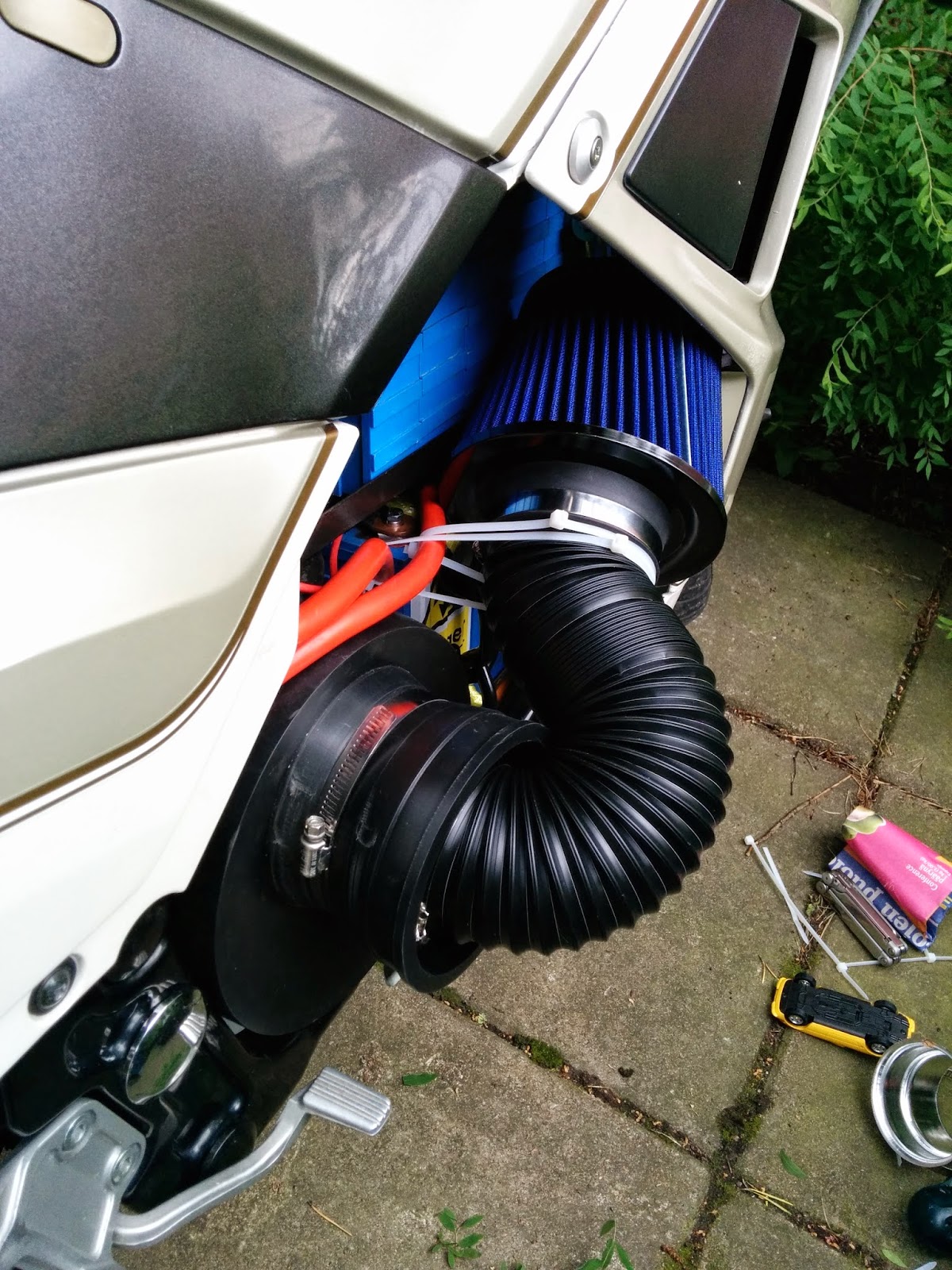
I improved the Air Intake Filtering System (AIFS, as I like to casually call it) a little bit. Still not the prettiest thing on the planet, but a little less protruding at least. I'll try to fix it a little more permanently once I have the new cells in.


On that note I have eight new CALB SE40AHA cells ready to rock. I noticed they have new cool vents with a little round cap on them that says CALB. I'll be sure to put these cells in the motorcycle so that they'll be the most visible ones. As for the bottom balancing, taking place here in the picture, I set my Professional Bottom Balancing Tool (or PBBT) to 2.7 volts, so the cells drained in parallel to 2.69 volts. The next day after disconnecting them from everything, including each other, they were at exactly 2.71 volts each. Shows that doing this in parallel works, all cells are good (bad cells would go down by themselves) and they are quite identical in all intents and purposes.

lauantai 14. kesäkuuta 2014

Temporary solution


I came up with a temporary solution to the air filter sticking out. The tube still sticks out almost as much, but... Well, I think it's a little better. I'll have to take the whole thing to my underground lair a little later for a proper fix. I'll try to include the electric fan in there then as well.


perjantai 13. kesäkuuta 2014

Sticking out


Ok. I suppose it sticks out... a little.

Air cleaner and water intake prevention

Since it's been raining cats and dogs for a few days and preventing me from driving the bike to work I got anxious to do something about the waterproofing of the DC motor in the kWsaki. Here's what I've come up with.


The tower consists of Biltema part numbers 88463 (hidden inside), 32323 (air filter) and 88471. I have an 8" fan which I'm also planning to put inside the big adapter piece, so that the motor will always have more than enough airflow, even at low rpm. I just don't have the fan with me right now. Pictures of the installation later.

Update: If you're wondering what this has to do with waterproofing, my thinking is that adding the filter and moving it a little further away would mean less water in the motor. Water entering the filter at standstill should also not find it's way inside the motor nearly as much as it does now. This setup also gives me the option of moving the intake filter somewhere else using some flexible tube.

tiistai 10. kesäkuuta 2014

kWsaki updated and running again


With the Energy Day coming up it was time to get the good ole kWsaki back into running condition. I had neglected it and scavenged parts from it for the car. It had lost it's AXE7245 controller, so it was time to give it the Kelly KDH12600D controller I had originally meant for the car, but the AXE had some features I needed there. Such as 0-5V throttle input, which the cheapo model Kelly doesn't have. It only supports 2-wire pot, which the Magura twist grip throttle in the motorcycle has anyway. 

The KDH12600D could go up to 136 volts and 600 amps, but it may not be a good idea to go so high. In any case I moved two SE40AHA cells away from the top row to make the front wheel clear a little better and made a place for five more cells for a total of seven cells in the bottom row. Not really a row, since it's four cells parallel to each other and two adjecent. That means there's now space for four more cells in the top row. That makes 29 cells in total for the whole vehicle and a "nominal" voltage of 84 V. That's actually 92.8 V with 3.2 V per cell, 102.2 V charge voltage and I'm expecting to see 96.7 volts after charging. Should give a bit more range and perhaps a way to reach highway speeds too.

When I had both 60 Ah and 40 Ah packs in parallel in the car, there was a problem that two of the 40 Ah cells were shooting to over 4 volts way before the others reached even nearly full state of charge. I didn't know whether this was because of this parallel setup or not. Now that I took the 40 Ah cells out and charged them alone, the same cells were hitting voltages around 4.5 volts. Scary zone, that is. It does however mean that parallel charging uneven packs may be just fine, just as I thought. Those two cells just have dimished capacity compared to the others, so I put in an order for 8 new SE40AHA cells to replace those two and a couple more cells to get the 29 cell pack together. I'll have 4 cells left over, at least two with lower capacity, but still a probably quite usable 12 volt pack, perhaps for the car or just for my test bench.


Kelly KDH12600D installed. The rusty bits got treated with some black paint.

torstai 15. toukokuuta 2014

Energiapäivä 2014 Pori


I promised to bring a handmade EV or two to this Sustainable Energy Fair on 7th of June in Pori.


tiistai 6. toukokuuta 2014

The long tailpipe... or the lack thereof


You probably have heard the argument that an electric vehicle has what is called a long tailpipe. What that commonly refers to is that electricity is produced by burning fossil fuels and thus the actual carbon dioxide emission of an electric vehicle is not zero. It just gets put out someplace else.

What is also commonly left out is that producing oil and refining it also uses electricity. Apparently they'd rather not let you know how much, but Robert Llewellyn here in the video has worked it out. And it is surprisingly much.

So how much really? It turns out it's around 1.2 kWh per litre. That's like using a microwave oven for an hour or more. It got me thinking. How much is that per kilometer?

Let's take a motorcycle which consumes 6l/100km on average. I think that's a pretty fair guess at a petrol motorcyle fuel consumption. I think my Z500 has a tank of about 14 litres and it can just get me from Helsinki to Pori, which is about 240 km.

So 6l/100km is about 16.7 km per one litre. One litre took 1200 Wh to produce. So 1200 Wh divided by 16.7 km is about 72 Wh/km. Now why does that sound so familiar? Oh, maybe it's because my electric DIY kWsaki motorcycle uses about 70 Wh/km! And not a drop of fuel! That's nothing short of amazing.

lauantai 17. elokuuta 2013

Taking apart

Yesterday I proceeded to take apart the battery pack of the kWsaki motorcycle. I'll need the cells for my initial build of the kWsara electric car. I'll see if I can get more batteries later for the car and/or the motorcycle. Of course if I can't get the car to pass MOT then I won't have to.

In any case I thought it would be a good idea to empty the pack before dismantling it. This way it would have the least power stored in case I mess something up in the process. It turned out to be a little challenging and I couldn't avoid letting some sparks fly, so I guess I was on the right track. The minus cable of the pack had slipped into contact with the positive end of the 12 V lead acid battery. A little slip of a wrench into the chassis of the matorcycle resulted in some fireworks along with the bolt in the end of the minus cable welding into the battery terminal.


So yeah, let's be careful out there. Other than that there were no mishaps. I had pushed the pack down to 50 volts, about 2 volts per cell, but it had bounced back to 74 volts by the time of disassembly. All but two cells were at 2.95-3.00 volts. The remaining two were at 2.71 and 2.80 volts. Not sure why, but I may have sucked them a little bit more empty while bottom balancing, they may have been worse cells, I may have hurt them by sucking them too low or maybe some of the sparks I've made have caused them to get a little bit more empty. The difference isn't very big though, since the voltage drops very quickly below three volts. All in all I'm not worried and will just add some more juice into those two cells or suck the others a bit lower.


The cells aren't very clean due to my open design of the battery box and the fact that the braces had rusted rubbing some of that rust into the cells. The cells whoever seemed quite uninterested in their external appearance. Perhaps a more close box would be in order though. The next incarnation of the battery pack will be different anyway, so I'll see what I can do. That's for next summer in any case. I took the bike off insurance for this season.

keskiviikko 17. huhtikuuta 2013

First ride of the season, car progress and more


Here's the bike after the first ride of the season. Only a little less than 20 km leisure cruise. Everything still works as before and top speed of the ride was 104 km/h. A total of 20.62 Ah or 1481.4 Wh was consumed. Max battery amps were 422.5 A and minimum voltage under load 57.2 V. The bottom fairing is missing because it needs cleaning and perhaps I will also modify it a little for hopefully improved aerodynamics. I also bought an extended front fender from ebay to reduce water and crap flying into the motor and batteries


My KP-K 2000 W charger doing it's thing. I just keep it in a large tank bag from Biltema. It just fits with enough clearance for air flow. All 20 amps going into the 40 Ah pack with no problem whatsoever. I'd charge faster if I had a bigger charger and was comfortable with pulling over 2000 W the usual Schuko plug. I had outlets with a 16 A fuse installed, but just the other day I noticed the charger's connector getting pretty hot. For faster charging better connectors would definitely be in order.


I also started putting together the motor with the flywheel, clutch and so on. It's a bit more ghetto than I'd like, but I'll have to make do with the time and the tools that I have. At least I'll have room for improvement later if I find myself bored and with too much time in my hands... Right, maybe in thirty years or so when I reach retirement.


A bit of news I actually picked up in the local newspaper, Fortum and Nissan along with the ABC! stations have teamed up to provide a network of 50 quick charge stations in Finland. With Nissan on board there should be no question of whether they'll be CHAdeMO or not. The good part is that it's the best option available right now. The bad is that it's highly proprietary and not available for free. However, I did find an open-chademo project which hopefully will make it possible for private converters to equip their vehicle with a CHAdeMO plug. Me included, I hope.

Update! Looks like the charging stations may actually have both CHAdeMO for 50 kW DC and Mennekes for 43 kW AC charging. At least according to this press release from last year. Nice!

sunnuntai 31. maaliskuuta 2013

New battery and first charge

New aux battery, 15 V PSU, main shunt and a fuse.

I installed a new auxiliary battery yesterday. It's a 12 V 12 Ah lead acid battery from Biltema, product number 80-268. I'm charging it with an old Toshiba laptop power supply, which puts out a maximum of 5 A at 15 V. It's a little high, but we'll see how this goes. Previously I used old, small UPS batteries, but they probably weren't very good for this purpose and pretty much died. Without the lights on the brick seemed to put out less than an amp, but when I turned on the headlights it ramped up to 5 A. Obviously it's mean for 100-250 VAC, but it seems to run from 80 VDC as well. If the main traction pack falls much below that it will give up, but I suppose that could actually be a good thing. At least it won't drain the pack empty.

That's my fully charged voltage for 25 CALB cells.

I also recharged the traction pack for the first time after the winter. It had been sitting about six months. I had used it to test the TTL200C motor a bit since the last charge and also gave the ME1003 motor in the motorcycle a little spin just before the charge. Only 1.39 Ah went in. So I can pretty safely say the cells haven't discharged by themselves at all. If I hadn't used the pack at all this would equal about 0.5% self discharge per month. Alas I have and no such thing exists. The specs on these cells aren't lying though. 0% is still below 3%. It's really just a number they came up with when they got tired of silly people asking what's the self discharge and they wouldn't believe there is none.


One last shot of the new Cycle Analyst placement from a slightly better angle. Very, very nice.

perjantai 29. maaliskuuta 2013

Spring is coming


It looks like spring is coming. For a nothern motorcyclist the sure signs are increasing amount of dry, ice free asphalt and the accompanying urge to tinker with two wheelers to get them ready for the season. Today I finally did something I had been thinking about since I got the bike inspected last summer. The Cycle Analyst was placed in a less than optimal location below the lock and rather badly in the way, not to mention hard to read while driving. Now it has moved to a better position above the original instrument panel. Looks very good and should be much more user friendly. Good times.

ps. I also lifted the bike on it's center stand, gave the motor a little spin and checked the cells. All came in at 6.56 or 6.57 volts a pair. I'd call that pretty well balanced.

perjantai 15. helmikuuta 2013

Cell drift

Or lack thereof. Yesterday, when the thermometer showed 0 degrees Celsius (or 32 Fahrenheit), I figured it would be time to go check the cells in my kWsaki electric motorcycle. I took the bike off insurance October 3rd so it's been sitting in the cold garage for about four and a half months. I gave one of the TTL-200C motors a quick spin with the kWsaki traction pack and controller, but I haven't recharged since October.

And when I said cold I meant it. The temperature here has regularly been below zero Fahrenheit and the cells have had to endure it. So I was a little excited when I started the measurements. First cell 3.299 V, second 3.299 V, no make it 3.300 V, next 3.299 V, 3.300 V, 3.300 V and so on. It got really boring really fast. I got a little bit of variance when I couldn't reach the terminals of a couple cells and I had to measure them in pairs. They read 6.61 V. A couple cells showed 3.31 V. This was after I had changed the meter's resolution from 0.000 to 00.00. The whole pack registered at 82.8 volts. For 25 cells that's 3.312 V each.

Considering that the meter is no Fluke and it showed a maximum variance of hundredth of a volt, I don't see evidence of cell drift. I've had nothing connected to the pack for these last months. Note that this is the same pack that I pushed down to 2 volts per cell earlier. If I had damaged any of the cells, they probably wouldn't be happily floating at 3.3 volts after being left to their own devices for months.

Conclusions are that cell drift has not been demonstrated and bottom balancing still seems to work.

If I had more money than I can spend, I could have gotten another 25 cells, put a MiniBMS on them and let them idle for over four months. Alas I do not, but the result is easy to guess. Anyone care to prove me wrong?

perjantai 21. syyskuuta 2012

In a magazine

There's a story about the bike in the latest WattiViesti, a customer magazine of the local electric company Pori Energia. There is an online version available. You can find the article on page six. It is naturally in Finnish and the online version unfortunately requires Flash as well.


tiistai 18. syyskuuta 2012

Bottom balancing to the rescue

Last night I rode my battery pack half empty and today added the 25th cell that arrived yesterday. I then proceeded to drive the pack completely empty so I could bottom balance the new cell as well. I dropped off some badges my S.O. had made, located a gas station not to fill up but to check tire pressure, picked up two salads from the local market and ran out of juice before getting home. Yes, I thought the pack would have 5 Ah more left, but alas it did not. I kept pushing against the 50 volt limit I had set in the controller, that's only 2 volts per cell, but couldn't get home without pushing for real.

I was more than a little worried that I had incorrectly estimated the state of charge of the new cell and now ruined it straight away, but it was not so. It was happily resting at 3.2 volts while the rest of the pack was around 2.5 volts per cell. I didn't take very long to go from very worried to very happy about how well bottom balancing had protected my precious cells. I hadn't been able to break them even by pushing them down to 2 volts. And I tried. The bike would just stop going as the cells refused to give more than a few amps and floated back from their lower limits with no problems whatsoever. I can therefore testify that bottom balanced cells will protect each other and not let you kill their colleagues.


I then turned my attention to the newcomer and drained it down to about 2.5 volts where the older cells were waiting, connected my 2 kW charger and let it do it's thing. About 40 Ah went in as expected. For the bottom balancing I used the electric motor of the bike itself.

perjantai 31. elokuuta 2012

New charger among other things

Got my big new charger yesterday. It really is big. However it does fit into my tank bag which makes it small enough to take on the road for a quick top up in about two hours from empty to fully charged. I also installed a LED light strip to function as a daytime running lamp as now permitted in the EU. This way I don't have to turn on the head or tail lights in daytime and thus save my 12 volt system from extra load. The LEDs are always on and take so little power I wasn't able to measure it with my ammeter.

But first here are couple of videos of my friend taking a ride with the kWsaki electric motorcycle. First taking off and coming back and then the actual footage from riding around Finnish countryside.


The first short video was shot with my Sony Xperia Pro phone and the latter with a GoPro on top of the tank. Here are also a couple of shots of the charger, DRL installation and an emergency cut off switch I also added which you can use to disengage the main contactor if there's trouble.