I have been talking to the local vehicle inspector about the UNECE R100 rule, also known in Finland as the "E100-sääntö". I thought it would help fellow converters in Finland to share what I've discovered.
As you may or may not be aware, the R100 is required from all conversions done in Finland. The local inspector whoever doesn't know anything about electrics, so what you need to have is someone with the proper qualifications to check the vehicle.
The next question is which version of R100 do you need to follow. The answer depends. Any vehicle must adhere to a version. Even if it's 1961 VW Beetle, you have to pick one to follow. There wasn't a R100 paper then, but nevertheless you need to follow one.
For a 1997 vehicle like mine you could go with the version that was in effect at the time of the first registration of the vehicle. That would to my knowledge be the 1995 version. However I can't find a version of it in finnish and the 2002 version, strangely published in 2009, seems to have pretty much the same text. So I'll probably go with that. You can always use a newer version.
What you don't want to do is pick the fresh August 2013 version. It seems to have some horrible requirements for the battery box construction, testing and so forth. Just goes to show that the OEMs are really trying to do everything in their power to stop people from building their own EVs.
All of this of course only applies to M and N class vehicles, or cars and vans. Motorcycles have no such requirements as far as I know. Unless of course they're new enough to require EMC testing.
As for the paper itself I still maintain that you should probably only be concerned of section 5, since it's the only section which really lists the requirements proper. The rest of it is definitions and type testing approval crap, so I believe you can ignore that. YMMV though...
ps. I've prepared a document with checkboxes to give to the electrician. It's in finnish. If you'd like a copy, throw me an email. The address is at the top the blog. It is still untested however.
sunnuntai 8. syyskuuta 2013

perjantai 6. syyskuuta 2013
Good old back and forth
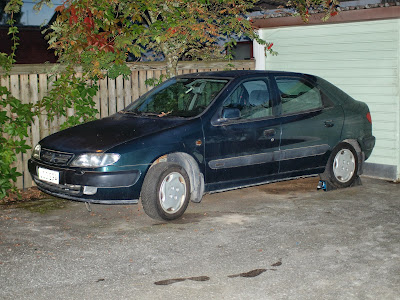
I had a little bit of the good old back and forth fun with the car last week. That's to say I got the 12 volt systems wired up as well so I could jump in the car, turn the key, flip a switch and press the acceleration pedal. Not just that, but even make the car move by doing so. And move it did. Shamefully I have zero photographic or video evidence of this event, unless you count this picture which shows that the vehicle has indeed turned around.
I tried third and fourth gears which both seemed fine for taking off. No clutch required, or available, for that matter. Reverse gear was a little bit more problematic. Too much power available resulting in jerky movement unless pressing the pedal extremely gently and letting go at least as gently. Probably this jerkiness was what bent my support structure too. Oh well. At least my welds were stronger than the thick angle iron! That's worth something, I suppose. Also goes to show much power a small 8" electric motor has.

It's also quite amazing how simple my 12 volt electrics are. Especially compared to the complicated original wiring of the petrol engine. I have most of the original wire bundle ziptied in place just to get the three wires that are required for the speedometer to work. Perhaps I will remove more of the extra wiring later. All the new electric car wiring is on top of the case which houses all the high voltage wiring and the 0-5k throttle. Just a few fuses and a single relay so far.

I've also been talking to the authorities and my plans for power brakes and steering seem solid. I'll need to implement more heat that I'll ever need, but I think I'll figure that out as well. For the UNECE R100 regulation the final word is that I'll need to have my wirings checked by a certified professional and get a paper for it. That should be enough for the "MOT" check. Sounds reasonable to me.


Aux battery still needs to be secured in place.

Needs a bit of tidying up.

The mess of original wiring. Actually in use: 3 leads.
keskiviikko 4. syyskuuta 2013
WattiViestin lukijoille
This post is in finnish, mainly for the readers of my writing in the local WattiViesti magazine.
Muutama lukija on ottanut yhteyttä WattiViesti-juttuni johdosta. On kyselty mm. mistä käytettyjä komponentteja mahtaisi saada. Omat moottorini löysin Sähköautot - Nyt! -sivuston foorumin ilmoituspalstan kautta. Valitettavasti käytettyjä komponentteja on Suomessa liikkeellä mielestäni varsin harvoin. Toisaalta kerran hankitut omat komponentit on mahdollista kierrättää ajoneuvosta toiseen. Eri asia sitten on, kauanko Trafi suvaitsee hyväksyä mitään muutoksia. Suunta ei ole ainakaan parempaan päin. Syytä toki pitää etsiä myös kauempaa sekä paikallisesta lainsäädännöstä että EU-tasolta.
Toinen kyselty asia on sähkömoottoreiden teho. Jotain osviittaa käytettyjen moottoreiden tehoista saa esimerkiksi katsomalla Kostovin moottoreiden vertailua. Sähkömoottori kuitenkin eroaa polttomoottoreista samaan tapaan kuin esim. Diesel-moottori eroaa bensamoottorista, mutta vielä radikaalimmin. Tehohuippua ei esimerkiksi ole vaan moottorin täysi vääntö on käytettävissä heti kierrokselta nolla. Muunnetulla sähköautolla voi täten lähteä liikkeelle paikaltaan ilman kytkintä esimerkiksi jopa 3- tai 4-vaihteella. Oma kWsara-projektini ainakin näyttää kotipihassa liikkuvan näillä vaihteilla ihan hyvin. Peruutusvaihteen välitys on turhankin tiheä ja auto tahtoo singahtaa taaksepäin.
Moottorin lisäksi tehoon vaikuttaa toki myös käytetty ohjain ja akusto. Omaan autooni tuleva ohjain toimii 120 volttiin ja 600 ampeeriin asti, joten sen laskennallinen huipputeho on 72 kW. Todellinen mitattu teho voi sitten olla jotain ihan muuta ja tuo vääntökäyrän erilaisuus kannattaa edelleen pitää mielessä. Sähkömoottorin vääntö kun on tasainen aina sen huippukierroksille asti, jonka jälkeen vääntö alkaa loivasti laskea. Näiden asioiden lisäksi akuston tulee myös pystyä antamaan riittävä määrä ampeereja ja voltteja "kyykähtämättä". Teho on siis sähköautossakin monen tekijän summa.
Voin listata käyttämieni komponenttien hankintapaikkoja sitten kun olen varmistanut, että niillä todella pääsee muutoskatsastuksesta läpi eikä Trafi ala vaatia jotain sellaista, jota heidän ei mielestäni pitäisi.
Muutama lukija on ottanut yhteyttä WattiViesti-juttuni johdosta. On kyselty mm. mistä käytettyjä komponentteja mahtaisi saada. Omat moottorini löysin Sähköautot - Nyt! -sivuston foorumin ilmoituspalstan kautta. Valitettavasti käytettyjä komponentteja on Suomessa liikkeellä mielestäni varsin harvoin. Toisaalta kerran hankitut omat komponentit on mahdollista kierrättää ajoneuvosta toiseen. Eri asia sitten on, kauanko Trafi suvaitsee hyväksyä mitään muutoksia. Suunta ei ole ainakaan parempaan päin. Syytä toki pitää etsiä myös kauempaa sekä paikallisesta lainsäädännöstä että EU-tasolta.
Toinen kyselty asia on sähkömoottoreiden teho. Jotain osviittaa käytettyjen moottoreiden tehoista saa esimerkiksi katsomalla Kostovin moottoreiden vertailua. Sähkömoottori kuitenkin eroaa polttomoottoreista samaan tapaan kuin esim. Diesel-moottori eroaa bensamoottorista, mutta vielä radikaalimmin. Tehohuippua ei esimerkiksi ole vaan moottorin täysi vääntö on käytettävissä heti kierrokselta nolla. Muunnetulla sähköautolla voi täten lähteä liikkeelle paikaltaan ilman kytkintä esimerkiksi jopa 3- tai 4-vaihteella. Oma kWsara-projektini ainakin näyttää kotipihassa liikkuvan näillä vaihteilla ihan hyvin. Peruutusvaihteen välitys on turhankin tiheä ja auto tahtoo singahtaa taaksepäin.
Moottorin lisäksi tehoon vaikuttaa toki myös käytetty ohjain ja akusto. Omaan autooni tuleva ohjain toimii 120 volttiin ja 600 ampeeriin asti, joten sen laskennallinen huipputeho on 72 kW. Todellinen mitattu teho voi sitten olla jotain ihan muuta ja tuo vääntökäyrän erilaisuus kannattaa edelleen pitää mielessä. Sähkömoottorin vääntö kun on tasainen aina sen huippukierroksille asti, jonka jälkeen vääntö alkaa loivasti laskea. Näiden asioiden lisäksi akuston tulee myös pystyä antamaan riittävä määrä ampeereja ja voltteja "kyykähtämättä". Teho on siis sähköautossakin monen tekijän summa.
Voin listata käyttämieni komponenttien hankintapaikkoja sitten kun olen varmistanut, että niillä todella pääsee muutoskatsastuksesta läpi eikä Trafi ala vaatia jotain sellaista, jota heidän ei mielestäni pitäisi.
torstai 29. elokuuta 2013
Get your motor running, again
Yesterday I spent the whole day working on the car. It was worth it though. I got the high voltage parts all wired up and the wheels spinning using the controller. Here's the proof.
I had the idea of putting the high voltage cabling inside some clear plastic tubing, but the cables didn't want to go in so I just gave up on that idea. The cables routed below the car doesn't look half to me though.

I had the idea of putting the high voltage cabling inside some clear plastic tubing, but the cables didn't want to go in so I just gave up on that idea. The cables routed below the car doesn't look half to me though.

Plenty of room below the car now. Kind of makes me sad to have all that space that cannot be easily put to use. Oh well. At least I got a lot of crap out that could fail the yearly check.
perjantai 23. elokuuta 2013
New cable
I finally found a good place to get some proper, orange 50 mm2 cable and other useful stuff for my electric car conversion. To my surprise the place to go to is IKH. They sell all kinds of tools and tractor parts, but also heavy cable and such. They had up to 70 mm2 right there in the shelf. I figured I could get away with 50 mm2. Especially since I'm not exactly creating a supercar.

I got 10 meters of the cable. I had some red cable from Biltema before that was 6 m in length, but it turns out it wasn't quite long enough. I hope 10 will do. Maybe I should have measured how much I need. I also got some clear 40 mm diameter tube to use as a conduit from the back of the car to the front. I got the idea from this Damien Maguire's youtube video:
Very nice, clean and hopefully durable solution. My cabling from first go from the trunk to below the read seats, where there are a couple of holes already available for bringing the cable down to the underside of the car and then using the exhaust pipe tunnel into the front.
The heater in the picture is a cheap 1000 W cabin heater. I'll see if the heating element would happen to work on 80 volts DC as well. The fan most likely will not work in any case.

I got 10 meters of the cable. I had some red cable from Biltema before that was 6 m in length, but it turns out it wasn't quite long enough. I hope 10 will do. Maybe I should have measured how much I need. I also got some clear 40 mm diameter tube to use as a conduit from the back of the car to the front. I got the idea from this Damien Maguire's youtube video:
Very nice, clean and hopefully durable solution. My cabling from first go from the trunk to below the read seats, where there are a couple of holes already available for bringing the cable down to the underside of the car and then using the exhaust pipe tunnel into the front.
The heater in the picture is a cheap 1000 W cabin heater. I'll see if the heating element would happen to work on 80 volts DC as well. The fan most likely will not work in any case.
tiistai 20. elokuuta 2013
Tank out, batteries in
Yesterday I finally took out the gas tank from the kWsara. Main motivation was to make room for battery cabling. I've decided to have a single simple battery box in the trunk for now. It's actually an aluminum box from Biltema. Right now it houses the 25 CALB SE40AHA 40 Ah cells from the kWsaki motorcycle. They should be good for about 30 kW and 3 kWh.


The battery box also houses the main contactor and a cut-off switch. Essentially all electric power can be contained within the box simply by turning the switch off. I also got some gland nuts for the cables to exit the box in a clean and secure way. Cables within the box are just 35mm2 for now, but the longer cables are 50mm2. I'll need to get some more though. The 6m roll of cable I got earlier doesn't reach to the front of the car and back.
Taking the tank out took some doing. First few bolts came off nicely, but just as I though I had them all out I found the last one. For some reason the last one always turns out to be the one rusted out and nigh impossible to remove. Eventually it did give up and I was able to wiggle the tank out from between the handbrake cables. Spilling of some gasoline left in the tank could not be completely avoided.

I also used a 5 V 2.5 A D-Link power brick to top up the the cells which we're a little lower than the rest. Now they seem to be quite happily resting at about 2.95 to 3.02 volts like the rest.
lauantai 17. elokuuta 2013
Taking apart
Yesterday I proceeded to take apart the battery pack of the kWsaki motorcycle. I'll need the cells for my initial build of the kWsara electric car. I'll see if I can get more batteries later for the car and/or the motorcycle. Of course if I can't get the car to pass MOT then I won't have to.
In any case I thought it would be a good idea to empty the pack before dismantling it. This way it would have the least power stored in case I mess something up in the process. It turned out to be a little challenging and I couldn't avoid letting some sparks fly, so I guess I was on the right track. The minus cable of the pack had slipped into contact with the positive end of the 12 V lead acid battery. A little slip of a wrench into the chassis of the matorcycle resulted in some fireworks along with the bolt in the end of the minus cable welding into the battery terminal.


In any case I thought it would be a good idea to empty the pack before dismantling it. This way it would have the least power stored in case I mess something up in the process. It turned out to be a little challenging and I couldn't avoid letting some sparks fly, so I guess I was on the right track. The minus cable of the pack had slipped into contact with the positive end of the 12 V lead acid battery. A little slip of a wrench into the chassis of the matorcycle resulted in some fireworks along with the bolt in the end of the minus cable welding into the battery terminal.

So yeah, let's be careful out there. Other than that there were no mishaps. I had pushed the pack down to 50 volts, about 2 volts per cell, but it had bounced back to 74 volts by the time of disassembly. All but two cells were at 2.95-3.00 volts. The remaining two were at 2.71 and 2.80 volts. Not sure why, but I may have sucked them a little bit more empty while bottom balancing, they may have been worse cells, I may have hurt them by sucking them too low or maybe some of the sparks I've made have caused them to get a little bit more empty. The difference isn't very big though, since the voltage drops very quickly below three volts. All in all I'm not worried and will just add some more juice into those two cells or suck the others a bit lower.


The cells aren't very clean due to my open design of the battery box and the fact that the braces had rusted rubbing some of that rust into the cells. The cells whoever seemed quite uninterested in their external appearance. Perhaps a more close box would be in order though. The next incarnation of the battery pack will be different anyway, so I'll see what I can do. That's for next summer in any case. I took the bike off insurance for this season.
tiistai 23. heinäkuuta 2013
kWsara original electrics
Not to be completely devoid of actual electric vehicle building I can report that I've been playing with the original electrical system of the Xsara, now known as kWsara. I haven't been able to get the original speedometer or tachometer working, but instead of I've figured out how to make all of the defunct instrumentation both inactive and silent. Silent especially concerning the immobilizer, which in addition to having a light lit also made a nasty sound for about half a minute when the key was turned. All this actually happened by just unplugging the fuse number 25. I also lost outside thermometer and clock, but those are hardly relevant.
What's interesting is that the owner's manual that came with the car seems to be completely wrong on a number of fuses. For example, I lost the cabin blower by unplugging number 21, even though it didn't have that listed. Also the very useful number 25 didn't list the immobilizer or instrumentation at all. Luckily the car came also with a Haynes manual, which I just happened to notice had the fuses listed as well. Turns out it's list was much more accurate or perhaps the owner's manual was missing some information intentionally so as to prevent fiddling about with stuff regular owner's are hardly encouraged to fiddle with.
Also an interesting discovery was made when I took out the glove box. I had been wondering why there were wires coming out of the fuse 5, which is for the ABS system, but hadn't given it much more thought. It all became clear when I noticed a hidden switch in the back of the glove box. Turns out some clever individual at some point in the car's life had decided he really didn't like ABS. I'm rather hard pressed as to why anyone wouldn't want such a useful system, but hey, people do a lot of things I don't understand at all.
Needless to say this possibility of unlegal ABS disablement came to an end and the mess of wires was one again replaced by the 10 A fuse that should be in slot 5. Additionally I've been able to solve the issue of front fog lights turning on automatically, which they obviously should not be doing. This was solved by disabling the automatic lights on feature which is common in cars around these parts, also by removing the fuse to that system. The real culprit is the left lever which controls the turn signals and lights in general. It seems to cause different problems in different french cars. In my 307 the worn left lever causes a similar, but slightly different problem of lights going from automatic on to full on at times, which causes the instrumentation light to flash on and off.
What I haven't solved yet is the issue of heat. In order to modify the heater core in this particular vehicle it would seem necessary to remove the whole dashboard. Not something I'd be terribly thrilled to do. The other option is to try to device liquid heating under the hood to produce the heated liquid which the petrol engine previously took care of. So it's down to dismantling the dash, liquid heating or some third option which I haven't thought of yet.
What's interesting is that the owner's manual that came with the car seems to be completely wrong on a number of fuses. For example, I lost the cabin blower by unplugging number 21, even though it didn't have that listed. Also the very useful number 25 didn't list the immobilizer or instrumentation at all. Luckily the car came also with a Haynes manual, which I just happened to notice had the fuses listed as well. Turns out it's list was much more accurate or perhaps the owner's manual was missing some information intentionally so as to prevent fiddling about with stuff regular owner's are hardly encouraged to fiddle with.
Also an interesting discovery was made when I took out the glove box. I had been wondering why there were wires coming out of the fuse 5, which is for the ABS system, but hadn't given it much more thought. It all became clear when I noticed a hidden switch in the back of the glove box. Turns out some clever individual at some point in the car's life had decided he really didn't like ABS. I'm rather hard pressed as to why anyone wouldn't want such a useful system, but hey, people do a lot of things I don't understand at all.
Needless to say this possibility of unlegal ABS disablement came to an end and the mess of wires was one again replaced by the 10 A fuse that should be in slot 5. Additionally I've been able to solve the issue of front fog lights turning on automatically, which they obviously should not be doing. This was solved by disabling the automatic lights on feature which is common in cars around these parts, also by removing the fuse to that system. The real culprit is the left lever which controls the turn signals and lights in general. It seems to cause different problems in different french cars. In my 307 the worn left lever causes a similar, but slightly different problem of lights going from automatic on to full on at times, which causes the instrumentation light to flash on and off.
What I haven't solved yet is the issue of heat. In order to modify the heater core in this particular vehicle it would seem necessary to remove the whole dashboard. Not something I'd be terribly thrilled to do. The other option is to try to device liquid heating under the hood to produce the heated liquid which the petrol engine previously took care of. So it's down to dismantling the dash, liquid heating or some third option which I haven't thought of yet.
sunnuntai 21. heinäkuuta 2013
Call for Top balancers
I'd like to hear from any readers who are using or advocating "Top balancing". Specifically, I'd like to hear how you do it and what science do you think it's based on.
To me it more and more looks like "Top balancing" is something that you can't even do they way you think it can be done. Massaging as much energy in the cells by "boiling" them at a certain voltage doesn't even seem to result in evenly charged cells.
There's a couple of ways you could try to convince me otherwise. First you could "Top balance" your pack as well you can, discharge and recharge. If you have indeed managed to "Top balance" your cells they should all become full at exactly the same time, each and every time. In other words, if "Top balancing" works you'd need to do it only once, just like you only need to Bottom balancing once. From what I've gathered this is not so. And if it isn't, then it doesn't really work. You may think they're all full and balanced at the Top, but what you're really measuring is charge voltage. Nothing else.
Another test I'd like you to do is to "Top balance" your pack as well as you can and then disconnect the whole pack from everything, including BMS and any load. Completely isolated. Let it rest a day or two. Record voltages from each cell. Are they the same? If not, they cannot be at the same State of Charge. Open circuit voltage seems to be indicative or charge state, but only when left disconnected for a long time. This is because the Lithium ions need to settle before the reading is realiable and also the reason why "Top balancing" based on charge voltage doesn't seem to be based on anything.
If you are a proponent of Cell drift, which I haven't seen at all, I'd like to keep those cells disconnected and record the voltage of each cell once a day for as long as you can bother. If cell drift does exist and is measurable, you should see your cell voltages start to go down and differ from each other. Ideally this should be done on a new pack which hasn't been massaged to death by excessive periods of "Top balancing". This is because I'm pretty sure you can see the cells doing all kinds of weird things if you've been torturing them by cooking them at say four volts for days.
Disclaimer: All of my battery ramblings are based on my own experience and Jack Rickard's findings. They are applicable to CALB SE- and CA-series cells. Other cells and chemistries may at least require different voltages.
keskiviikko 10. heinäkuuta 2013
All kinds of progress
I've been making all kinds of progress. The motor is mounted to the car and I also decided on a controller. In fact, I went ahead and ordered the whole lot, including the controller, a DC/DC converter and an assembly for the controller.
But first things first. I pieced together something to firmly attach the four points that needed attaching. The motor itself, the transmission, the drive shaft and one of the original motor mounts. The only way to get it done was to just try to position everything the way they seemed want to be and start welding together pieces of steel to keep them there permanently.
I think it came out quite fine. You can judge for yourself be looking at the pictures below. The little triangular piece attaches the drive shaft and the motor from below.


But first things first. I pieced together something to firmly attach the four points that needed attaching. The motor itself, the transmission, the drive shaft and one of the original motor mounts. The only way to get it done was to just try to position everything the way they seemed want to be and start welding together pieces of steel to keep them there permanently.
I think it came out quite fine. You can judge for yourself be looking at the pictures below. The little triangular piece attaches the drive shaft and the motor from below.


I was browsing the Kelly Controls website when I came across their KHD12600D controller, which they had on sale. I added the assembly for it and a DC/DC converter too. They had reasonable prices and also reasonable shipping fees, which is not usually the case. They came through amazingly as well. I put in the order on Sunday, got an email from Kelly on Monday and DHL delivered the package today, Wednesday. Ten out of ten for both Kelly and DHL.


As you can see the controller came fully assembled with contactor, pre-charge resistor, diode and fuse. Very nice. The only ugly part was the crap on the other end of the DC/DC converter. Not very professional. Tried to clean it up a bit myself to make it a little more bearable. That was after I had taken the photo.
Next up mounting the assembly into the car and loaning the battery pack from the kWsaki electric motorcycle. Obviously a box to put the batteries in must also be deviced. After that it should be time for a little test drive. If that goes well I'll need to tackle the nasty but important power brakes and cabin heating.
Tilaa:
Blogitekstit (Atom)