perjantai 11. heinäkuuta 2014

New charger for kWsaki

Yesterday, I finally got the new charger for the kWsaki. DHL and their local agent tried to make it as complicated as possible, but finally I just drove to their warehouse at 17.20 on a Friday and picked the damn shipment myself. Luckily they were still there. I think I'll specify pickup from there now on.


In the usual evassemble.com fashion, the charger was very lightly packaged and once again came in a little damaged. This time it was one of the cooling fins. Shouldn't be a problem, though. It's a little bigger than I thought, but I still believe I should be able to fit it under the frame and within the bottom fairing.


The charger seems to have been correctly configured, at least according to the sticker. It says 28 cells, but I'll use 29 instead. I just didn't want to complicate their life by specifying anything out of the ordinary. 102 volts divided between 29 cells comes down to about 3.52 volts per cell. The charger, charging at 21 amps, should fill my 40 Ah cells in about two hours, while using 11 amps at 230 VAC.


Look! It came with instructions too! "Connet black and red wire together to start automatic control." Yes, that was the only documentation in the package. In that box there was the control cable which the comprehensive documentation refers to and an additional Anderson connector. Most likely I'll just leave the Anderson connectors out, because they're mostly just asking for trouble.

tiistai 8. heinäkuuta 2014

Regarding temperatures

While doing the battery test drive for the previous post we also had the hottest day of the summer so far. Temperatures were around 28 degrees Celsius. Very hot for these parts. Just last week we had more than 10 degrees less, albeit it was particularly cold then.

After driving the battery empty in two 30+30 minute drives, with about 30 minutes in between, both the motor casing and the controller case showed an external temperature of around 60 degress Celsius. Rather hot, but the motor is rated for 80 degrees and the controller starts throttling gradually at 85 degress Celsius, so not a problem. I didn't notice the controller throttling while driving. I did curse myself for not logging it's data though. It would have been interesting.

The DC/DC converter wasn't really even warm, but the aluminum sheet that both the controller and the converter are attached to did show temperatures close to 50 degrees, so it was working as a heatsink as planned.

As for the batteries, in their closed and rather insulated case, were also noticeably warm to the touch. My infrared meter showed them at around 50 degrees. Kind of approaching uncomfortable zone, but not reaching it. I did however check how the temperature reacted while charging. It didn't go up, but instead came down to 45 degrees rather quickly and I didn't notice it going back up. All good then.

Ambiguity of energy consumption

Yesterday I took it upon myself to see just how far I could get with just the single set of 60Ah CALB SE cells that I currently have in the car. That part of the equation is rather clear. It's 25 kilometers or a little over 15 miles. How much energy was used, now that's a different question altogether.

I did measure the amount of energy used by the charger to charge the pack from quite empty to 87.6 volts or 3.5 volts per cell, with a CC/CV charge pattern. The result came in at 5.8 kWh. Now I don't know how accurate my cheap watt meter is, but if we assume it's anywhere near the thruth, the mileage from the wall was 232 Wh/km. Not bad, considering it was mixed city driving and no regen.

I suppose that's actually the most realistic way of measurement. After all, it determines how much you'll end up paying for your kilometers. That comes down to a little over 2 cents per km with our electricity prices, by the way. Or 2,32€ per 100km.

Nevertheless, it would be nice to know how much the actual driving uses. If we assume 90% efficiency in charging, we get 5220 Wh. Or about 209 Wh/km. Even better. The pack should however contain about 4800 Wh, or 60 Ah times 80 volts. That way the result is 192 Wh/km.

My Cycle Analyst however sees things quite differently. It measured 62.6 Ah into the pack and 87.8 Ah out while driving. It's obviously not counting the Coulombs quite correctly. I'll have to try and figure out why that is and make the numbers match. For now, I know I can drive the car quite a bit further than the Cycle Analyst numbers would indicate.

As for the range, the 25 km for a 25 cell pack of 60 Ah cells is pretty much dead on for what I had guesstimated beforehand. Doubling the cell count should double the range and give me the 50 km I had in mind originally. That's about 80 € per kilometer in battery cost with these cells.

keskiviikko 2. heinäkuuta 2014

Live for speed

Well, some speed at least. I did a little top speed test with the kWsara a couple weeks back. It was raining cats and dogs, so the circumstances were far from perfect. Nevertheless, I reached a top speed of 84 km/h (or 52 mph) on fifth gear while consuming approximately 22 kW. Not a whole lot, but rather predictable though.

The car was a petrol model, which revved several thousand rpm, so the gearbox has rather low gearing for the electric motor, which only likes to rev 2000-3000 rpm. So when 1000 rpm equals about 35 km/h on the fifth gear, you end up with less than 90 km/h at 2500 rpm. Other factors include voltage sag, which may have an effect since I still only have single set of 60 Ah cells in, and the tires, which are now the stock 185/65R14.

I'll get more cells before long to keep the voltage as high as it can be and I also just today picked up these 15" rims. They're meant for a Peugeot 307, just like my daily driver, but should also fit the Xsara. Both vehicles are from the same parent company, PSA, anyway. I'll get 185/65R15 or 195/65R15 tires for them at some point. That should increase the top speed by some 10-15% as well.


I know, the rims have the Peugeot lion on them, instead of the Citroën logo, but as I said, they are made by the same company. Also I don't really care.

For a bigger increase in top speed I'd have to spring for a transmission from a diesel model, but changing transmissions... Well, not my cup of tea.

perjantai 27. kesäkuuta 2014

Better, yes?


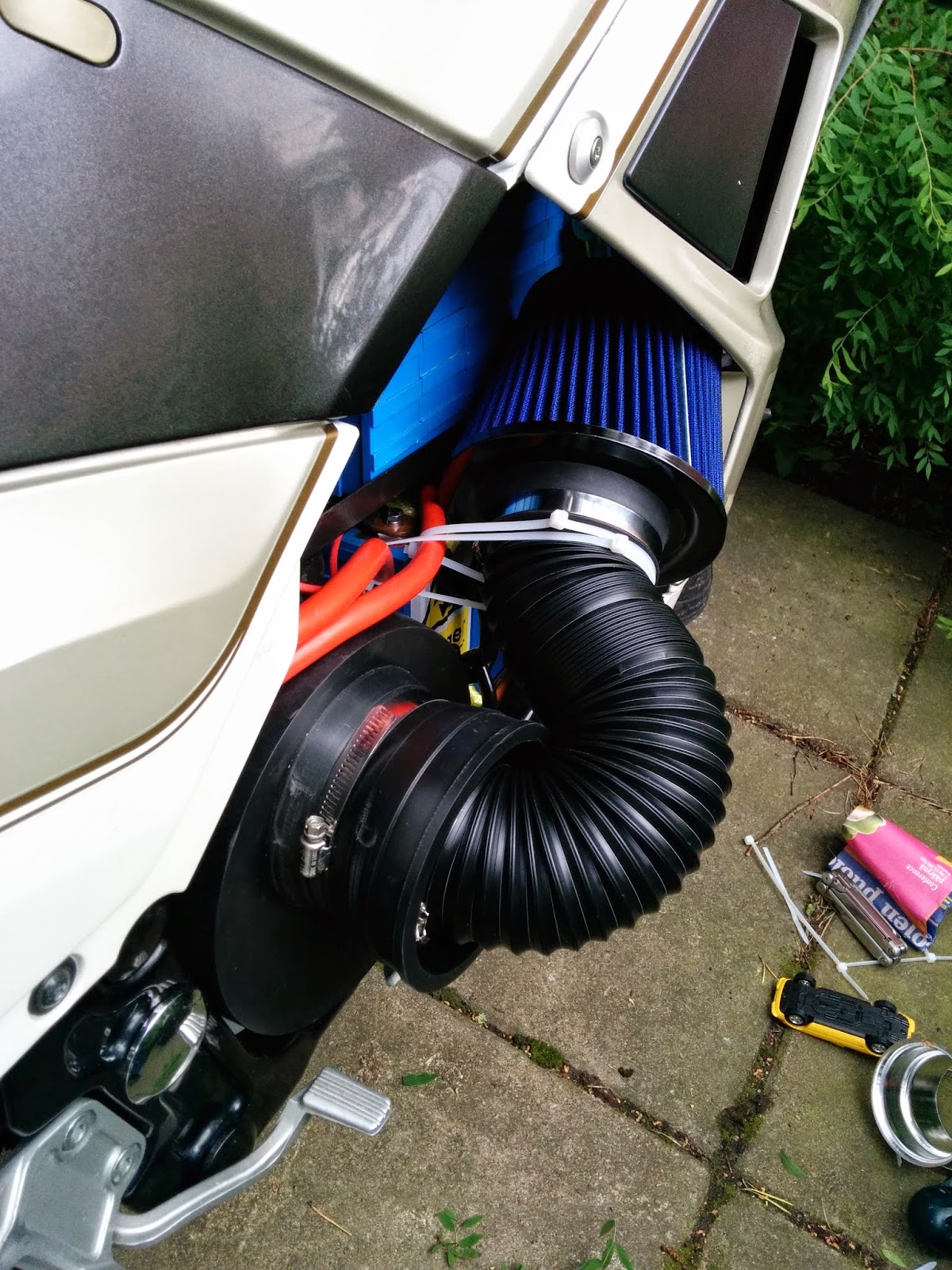
I improved the Air Intake Filtering System (AIFS, as I like to casually call it) a little bit. Still not the prettiest thing on the planet, but a little less protruding at least. I'll try to fix it a little more permanently once I have the new cells in.


On that note I have eight new CALB SE40AHA cells ready to rock. I noticed they have new cool vents with a little round cap on them that says CALB. I'll be sure to put these cells in the motorcycle so that they'll be the most visible ones. As for the bottom balancing, taking place here in the picture, I set my Professional Bottom Balancing Tool (or PBBT) to 2.7 volts, so the cells drained in parallel to 2.69 volts. The next day after disconnecting them from everything, including each other, they were at exactly 2.71 volts each. Shows that doing this in parallel works, all cells are good (bad cells would go down by themselves) and they are quite identical in all intents and purposes.

lauantai 14. kesäkuuta 2014

Temporary solution


I came up with a temporary solution to the air filter sticking out. The tube still sticks out almost as much, but... Well, I think it's a little better. I'll have to take the whole thing to my underground lair a little later for a proper fix. I'll try to include the electric fan in there then as well.


perjantai 13. kesäkuuta 2014

Sticking out


Ok. I suppose it sticks out... a little.

Air cleaner and water intake prevention

Since it's been raining cats and dogs for a few days and preventing me from driving the bike to work I got anxious to do something about the waterproofing of the DC motor in the kWsaki. Here's what I've come up with.


The tower consists of Biltema part numbers 88463 (hidden inside), 32323 (air filter) and 88471. I have an 8" fan which I'm also planning to put inside the big adapter piece, so that the motor will always have more than enough airflow, even at low rpm. I just don't have the fan with me right now. Pictures of the installation later.

Update: If you're wondering what this has to do with waterproofing, my thinking is that adding the filter and moving it a little further away would mean less water in the motor. Water entering the filter at standstill should also not find it's way inside the motor nearly as much as it does now. This setup also gives me the option of moving the intake filter somewhere else using some flexible tube.

tiistai 10. kesäkuuta 2014

Energy Day 2014 in Pori


There we were. My EVs next to a Tesla. Quite a few of people stopping by and asking a lot of questions. I think my DIY projects gathered more interest than the Model S. It is just an OEM car anyway.


Well, at least there were a lot of people until it started pouring. During the rain, not so much.


I can't say I couldn't some use for one. Looks smaller than it is, really. I'd need mine with all 7 seats.


Something interesting I noticed. Rust. I've heard that the attention to detail is good compared to it's other countrymen, but I suppose an american car is still an american car. Not cool.


kWsaki updated and running again


With the Energy Day coming up it was time to get the good ole kWsaki back into running condition. I had neglected it and scavenged parts from it for the car. It had lost it's AXE7245 controller, so it was time to give it the Kelly KDH12600D controller I had originally meant for the car, but the AXE had some features I needed there. Such as 0-5V throttle input, which the cheapo model Kelly doesn't have. It only supports 2-wire pot, which the Magura twist grip throttle in the motorcycle has anyway. 

The KDH12600D could go up to 136 volts and 600 amps, but it may not be a good idea to go so high. In any case I moved two SE40AHA cells away from the top row to make the front wheel clear a little better and made a place for five more cells for a total of seven cells in the bottom row. Not really a row, since it's four cells parallel to each other and two adjecent. That means there's now space for four more cells in the top row. That makes 29 cells in total for the whole vehicle and a "nominal" voltage of 84 V. That's actually 92.8 V with 3.2 V per cell, 102.2 V charge voltage and I'm expecting to see 96.7 volts after charging. Should give a bit more range and perhaps a way to reach highway speeds too.

When I had both 60 Ah and 40 Ah packs in parallel in the car, there was a problem that two of the 40 Ah cells were shooting to over 4 volts way before the others reached even nearly full state of charge. I didn't know whether this was because of this parallel setup or not. Now that I took the 40 Ah cells out and charged them alone, the same cells were hitting voltages around 4.5 volts. Scary zone, that is. It does however mean that parallel charging uneven packs may be just fine, just as I thought. Those two cells just have dimished capacity compared to the others, so I put in an order for 8 new SE40AHA cells to replace those two and a couple more cells to get the 29 cell pack together. I'll have 4 cells left over, at least two with lower capacity, but still a probably quite usable 12 volt pack, perhaps for the car or just for my test bench.


Kelly KDH12600D installed. The rusty bits got treated with some black paint.